Fashion imagery sells a feeling before it sells a product. The coat isn’t just a coat — it’s a lifestyle, a status, a version of yourself you might become. That aspiration is not captured by the camera alone. It’s built in post-production, image by image, by a skilled fashion photo editor who understands not just retouching technique but the visual language of fashion itself.
Fashion photo editing is the creative and technical process of transforming raw fashion imagery into polished, brand-aligned visuals that sell — for runway campaigns, lookbooks, eCommerce listings, editorial spreads, and social media content. It’s where the color temperature of a studio becomes a brand aesthetic. Where a model’s skin goes from real to ideal. Where a garment’s wrinkles disappear and its color becomes exactly what it looks like on the rail in the showroom.
Done well, fashion photo editing is completely invisible. The viewer doesn’t see the editing — they see a world they want to inhabit. This guide is for brands, photographers, and agencies who want to understand how that world is created — and how to get results that compete at the level fashion buyers and consumers expect in 2026.
The Four Types of Fashion Imagery — and Why Each Is Edited Differently
Fashion brands don’t produce one type of image — they produce several, for different contexts, audiences, and purposes. Each type demands a fundamentally different editorial approach from the fashion photo editor. Understanding this is the starting point for any professional fashion editing brief.
Campaign and Editorial Imagery
Campaign images are the brand’s most powerful visual statement. Shot on location or in high-end studio sets, campaign imagery communicates aspiration, emotion, and brand world — and the editing reflects that ambition. Retouching is thorough and technically demanding: frequency separation skin work, precise dodge and burn to sculpt light and shadow, confident color grading with a defined creative look, and careful background work that places the model precisely in the visual world the brand is constructing.
Campaign editing is the most creatively demanding fashion photo editing — every decision is a brand statement. The color grade isn’t just a technical correction; it’s a visual signature. The contrast isn’t just clarity; it’s attitude. A skilled fashion photo editor working on campaign imagery doesn’t just retouch — they participate in the visual direction of the brand.
Lookbook Imagery
Lookbooks occupy the middle ground between campaign and eCommerce — aspirational enough to inspire, clear enough to sell. Editing for lookbooks needs to show garments in their best light while keeping the styling, model, and environment all visible and accurate. Color accuracy for the clothing is critical — a coat that looks charcoal in the lookbook but arrives dark navy destroys buyer confidence. Skin retouching is polished but lighter than campaign level; color grading is brand-consistent but not aggressively stylized.
eCommerce Product Images — On-Model

On-model eCommerce fashion editing has one unambiguous priority: show the garment accurately and attractively on a human body, against a clean background, at the correct color. The model should look polished but not over-retouched — buyers need to believe the image represents what they’ll receive. Background must be pure white (RGB 255,255,255) for marketplace compliance. Color must match the physical product. Garment wrinkles need cleaning. Skin retouching is light and natural. This is high-volume, systematized fashion photo editing — efficiency and consistency at scale matter as much as quality on any individual image.
Social Media Content
Social media fashion editing — particularly for Instagram and TikTok — operates by different rules. Fast, vibrant, scroll-stopping. The retouching may be lighter, the color grades bolder, the crops tighter. Feed consistency matters: a brand’s grid should feel cohesive across dozens of posts, which means the fashion photo editor needs to apply a consistent color treatment across all social content regardless of the varying shooting conditions each image was created in.
| Image Type | Editing Intensity | Color Grade | Primary Goal |
|---|---|---|---|
| Campaign / Editorial | High — full creative | Defined, artistic | Emotion, brand world, aspiration |
| Lookbook | Medium — polished | Brand-consistent, accurate | Inspire + inform |
| eCommerce on-model | Medium — systematic | Neutral, accurate | Sell accurately at scale |
| Social media | Light to medium | Bold, feed-consistent | Stop the scroll, build feed identity |
Garment Editing — The Part Fashion Brands Often Overlook
Most discussions of fashion photo editing focus on skin retouching and color grading. But for fashion brands, the garment itself is the product — and garment editing is equally important, and often more technically demanding than the model retouching happening in the same image.
Wrinkle and Crease Removal
Every garment develops stress wrinkles under studio lighting — particularly at natural fold points (elbows, knees, waist). Some of these wrinkles are natural and should stay; others are distracting and need to go. A skilled fashion photo editor distinguishes between wrinkles that communicate fabric character (the natural drape of a linen blazer, the structured fold of a tailored trouser) and those that simply look bad in an image (a sharp stress crease across a dress caused by the model’s pose). The former stays; the latter is removed with the Healing Brush, Clone Stamp, or Liquify tool as appropriate.
Fabric Color Accuracy
Fabric color under studio lighting is almost never the same as fabric color in natural light — or as fabric color on the rail in the showroom. Tungsten lights push warm fabrics orange. Daylight-balanced LEDs can shift navy toward cobalt. A black fabric photographed against a dark backdrop can lose all shadow detail. Professional fashion color correction corrects these lighting-induced color shifts to ensure the garment in the image matches the garment the buyer will receive — using physical fabric samples or brand Pantone/hex references as the correction target.
Surface Detail — Threads, Lint, Labels
Studio lighting is ruthless — it reveals every stray thread, every piece of lint, every slightly-askew care label. At full resolution, these details are clearly visible and signal poor quality to buyers who zoom in on eCommerce listings. Systematic garment surface cleaning is a mandatory part of professional fashion photo editing — methodically removing these imperfections while preserving the fabric’s natural texture and character.
Fit Adjustment and Shape Correction
Garments sometimes don’t sit perfectly on a mannequin or a model — a shoulder seam that’s sitting slightly off, a waistband that’s twisted, a hem that’s falling unevenly. Subtle Liquify corrections can fix these fit issues, making the garment appear to sit and drape exactly as the designer intended. This is among the most delicate garment editing tasks — corrections must be invisible, preserving the natural physics of how the garment hangs and moves.
Ghost Mannequin — Fashion’s Most Efficient eCommerce Technique
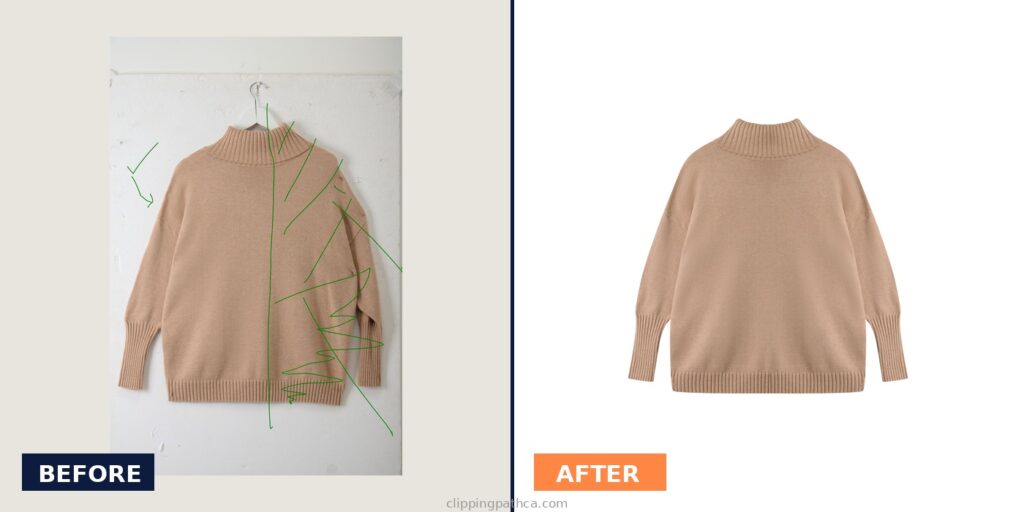
For fashion brands shooting standalone garments without a live model, ghost mannequin editing — also called invisible mannequin or neck joint editing — is the technique that presents clothing in its naturally worn, three-dimensional shape without a visible support structure.
The process involves shooting the garment on a physical mannequin (typically white or grey, to facilitate clean masking), then using Photoshop to remove the mannequin entirely — leaving only the clothing, shaped exactly as it would appear when worn. A composite interior shot fills the hollow left at the neck, collar, and hem, creating the illusion of a garment worn by an invisible body.
Ghost mannequin fashion photo editing consistently produces 33–40% higher conversion rates compared to flat lay photography for structured garments — because buyers can see exactly how the piece fits, sits, and drapes. Our specialist ghost mannequin service handles the full range of garment types, from t-shirts and tops to structured outerwear, dresses, and complex tailoring.
Key ghost mannequin editing challenges by garment type:
- Jackets and coats — collar structure, lapels, multiple interior shots needed for complex builds
- Dresses — full body mannequin removal, waist and hem interior compositing
- Knitwear — texture preservation at masked edges, preventing flat or cut-off look
- Lingerie and delicates — fine masking, sheer material handling, translucency preservation
- Children’s clothing — small scale, decorative detail preservation, bright color accuracy
Fashion Photo Editing That Sells
Clipping Path CA delivers professional fashion photo editing for brands, agencies, and photographers worldwide — ghost mannequin, color correction, skin retouching, background removal. From $0.25/image, 24-hour turnaround.
Color Grading in Fashion — Building a Brand’s Visual Identity
Color grading is where fashion photo editing becomes genuinely creative — and where a fashion photo editor’s role expands from retoucher to visual strategist. The color grade applied across a fashion brand’s imagery is as much a part of its brand identity as its logo, typography, or garment design. It’s the invisible thread that makes 50 different images from 5 different shoots feel like they belong to the same world.
Signature Aesthetics by Fashion Segment
Different fashion market segments gravitate toward different color aesthetics — and a skilled fashion photo editor understands these conventions while knowing when to break them:
| Fashion Segment | Typical Color Aesthetic | Key Grade Characteristics |
|---|---|---|
| Luxury / High Fashion | Desaturated, cool, high contrast | Lifted blacks, cool shadows, restrained saturation |
| Contemporary / Mid-Market | Clean, accurate, slightly warm | Neutral balance, gentle warmth in highlights |
| Fast Fashion / High Street | Vivid, bright, high energy | Boosted saturation, punchy contrast, vibrant skin |
| Sustainable / Organic | Natural, earthy, muted | Warm earth tones, soft contrast, desaturated greens |
| Streetwear / Urban | Gritty, high contrast, graphic | Hard shadows, cool cast, strong grain sometimes |
| Bridal / Occasion | Soft, luminous, romantic | Warm highlights, glowing skin, airy whites |
Seasonal Color Consistency
Fashion brands release collections seasonally — and each season typically gets its own color treatment that reflects the collection’s mood and the brand’s seasonal direction. A fashion photo editor working across a season needs to maintain perfect color consistency across every image in that campaign, regardless of the varying shooting conditions, lighting setups, and locations used across different shoot days. This is achieved through developed season-specific Lightroom presets or Photoshop LUT (Look-Up Table) files applied as adjustment layers across the batch.
Skin Tone Accuracy Across Diverse Models
Fashion brands in 2026 work with diverse model casts — and a fashion photo editor must handle skin tone correction accurately across the full range of human skin tones, not just the limited range that older retouching conventions were designed around. Different skin tones respond differently to the same studio lighting, create different shadow depths, and require different white balance corrections. A skilled fashion photo editor applies color grading that enhances each skin tone accurately rather than flattening diverse skin into a uniform correction.
Read more: Professional Color Correction Services — Brand-Accurate Color for Every Image
Fashion Photo Editing for eCommerce — Scale Without Compromise
Fashion eCommerce creates a specific editing challenge that campaign photography doesn’t: volume. A mid-sized fashion brand launching a seasonal collection might produce 200–500 new product images in a single shoot week. A large retailer might process thousands of new SKUs per month. At that volume, the quality of individual image editing matters — but so does the efficiency, consistency, and platform compliance of the editing pipeline as a whole.
Marketplace Image Requirements for Fashion
Major fashion marketplaces have strict and specific image requirements that professional fashion photo editing must satisfy:
| Platform | Background | Min Size | Fashion-Specific Notes |
|---|---|---|---|
| Amazon Fashion | Pure white RGB 255,255,255 | 1000×1000px | No mannequins, props, or text in main image |
| ASOS | White preferred on-model | 1200×1600px | Portrait format, consistent model framing |
| Zalando | White or light grey | 762×1100px | Portrait format mandatory, strict framing guide |
| Shopify store | Any (white recommended) | 800×1000px+ | Portrait or square, consistent across catalog |
| Myntra | White background | 1500×1500px | Ghost mannequin or flat lay required for some categories |
Catalog Consistency at Scale
The most important quality attribute for fashion eCommerce editing at volume is consistency — every garment in the catalog must receive the same background treatment, the same color temperature, the same framing, and the same retouching standard. Inconsistency across a catalog is immediately visible to buyers and signals poor brand execution. Professional fashion eCommerce photo editing services apply defined style guides systematically across entire catalogs, ensuring the 500th image is as consistent as the first.
Multi-Format Delivery
Fashion brands often need the same product image in multiple formats — pure white background for Amazon, lifestyle crop for Instagram, portrait format for Zalando, square for Shopify. A well-structured fashion photo editing workflow delivers all required format variants from a single source edit, rather than re-editing the same image multiple times for different platforms.
What Separates a Great Fashion Photo Editor from an Average One
Fashion photo editing is a specialist discipline — and not all retouchers are fashion retouchers. Here’s what distinguishes genuinely skilled fashion photo editors from generalist retouchers applying generic techniques to fashion images:
Visual Fashion Literacy
A great fashion photo editor understands fashion — how garments are supposed to fit, what a particular fabric’s texture should look like, how the silhouette of a well-structured jacket reads differently from a relaxed streetwear piece. This visual literacy means they make better retouching decisions — knowing which wrinkle to remove and which one communicates the garment’s natural character, knowing when a color correction makes a fabric more accurate and when it makes it look artificial.
Understanding Brand Visual DNA
Every fashion brand has a visual DNA — a consistent aesthetic that appears across its imagery season after season. A skilled fashion photo editor reads this DNA from the brand’s existing imagery, their campaign references, and their explicit style guide — and applies it accurately to new images, ensuring every new campaign frame feels like it belongs to the brand’s existing visual universe.
Knowing When Not to Retouch
Some of the best decisions in fashion photo editing are what to leave alone. Natural skin texture on a high-fashion image that’s going for a raw editorial aesthetic. The intentional grain in a film-shot campaign. The slightly imperfect drape of an organic cotton piece that communicates the fabric’s natural character. Heavy-handed retouching of these elements would make the image technically “cleaner” and creatively worse. Great fashion photo editors have the restraint to know when to stop.
Technical Precision on Complex Tasks
Fashion images regularly require the most technically demanding editing tasks in commercial photography — fine lace masking, sheer fabric handling, intricate print pattern preservation, precise neck joint compositing for ghost mannequin work. These tasks require patience, skill, and the manual attention that no AI tool can reliably substitute for. A fashion photo editor who approaches these tasks with the required precision produces results that look natural and professional. One who rushes them produces images that immediately reveal the editing.
The Fashion Photo Editing Workflow — From Shoot Day to Publication
A professional fashion photo editing workflow runs in parallel with the shoot calendar — not behind it. Here’s how it works from shoot day through to publication:
- Shoot day — RAW files are captured and backed up immediately post-shoot. Tethered shooting where possible allows immediate review and on-set color checking
- Ingest and backup — files are imported into Lightroom, organized by shoot date and product SKU, and backed up to at least two locations before editing begins
- Culling — best frames are selected per SKU and per look, checked for focus, exposure, and expression/garment positioning
- Global corrections in Lightroom — white balance correction, exposure, lens correction, and application of season preset applied across all selects
- Photoshop retouching — detailed garment retouching, background removal, skin retouching for on-model shots, ghost mannequin compositing where required, shadow creation, and color-matching to physical samples
- Quality control — every image reviewed against style guide: background purity check, color consistency across batch, edge quality on background removal, garment surface cleanliness
- Multi-format export — final images exported in required formats, dimensions, and naming conventions for each target platform
- Client delivery — files delivered via shared cloud folder (Dropbox, Google Drive) with delivery note confirming specifications met
For fashion eCommerce brands working at volume, stages 4–7 are handled entirely by a professional fashion photo editing service — freeing the in-house team to focus on creative direction, shoot production, and commercial strategy.
Read more: Post Production Photo Editing — Complete Workflow Guide
Fashion Photo Editing — Pricing Guide 2026
| Service | Price Per Image | Typical Use |
|---|---|---|
| Background removal + white background | $0.50 – $2.00 | eCommerce catalog, all garment types |
| Ghost mannequin (standard garments) | $3.00 – $6.00 | Tops, t-shirts, basic outerwear |
| Ghost mannequin (complex garments) | $6.00 – $12.00 | Dresses, tailoring, layered pieces |
| Color correction + garment retouching | $2.00 – $6.00 | Catalog accuracy, all categories |
| On-model fashion retouching | $5.00 – $20.00 | Lookbook, campaign, eCommerce on-model |
| Campaign / editorial retouching | $20.00 – $80.00 | Brand campaigns, press imagery |
| Volume catalog (100+ images/month) | Custom — significant discount | Fashion brands, retailers, agencies |
Frequently Asked Questions
What is fashion photo editing?
Fashion photo editing is the post-production process applied to fashion images — including garment retouching, skin retouching for on-model shots, color correction, background removal, ghost mannequin compositing, and color grading — to produce polished, brand-aligned images for campaigns, lookbooks, eCommerce, and social media.
What does a fashion photo editor do?
A fashion photo editor handles the post-production of fashion imagery — retouching garments and models, applying brand-consistent color grades, compositing ghost mannequin images, removing and replacing backgrounds, and delivering finished images to the exact specifications required for each sales channel or publication.
How long does fashion photo editing take?
Standard eCommerce fashion editing — background removal, basic garment retouch, color correction — is typically delivered within 24–48 hours by professional services. Ghost mannequin editing runs 24–72 hours depending on garment complexity. Campaign-level retouching varies significantly based on scope, typically 2–5 days per set.
What is the best software for fashion photo editing?
Adobe Photoshop and Adobe Lightroom Classic are the industry standard tools for fashion photo editing. Photoshop handles detailed retouching, ghost mannequin compositing, background work, and color grading. Lightroom handles global corrections, batch processing, and preset application across large fashion catalogs.
How much does fashion photo editing cost?
Fashion photo editing costs range from $0.50–$2/image for standard background removal and basic eCommerce retouching, to $6–$12/image for ghost mannequin editing on complex garments, to $20–$80/image for campaign-level on-model retouching. Volume discounts are available for brands processing 100+ images per month.
Can fashion photo editing be outsourced?
Yes — fashion photo editing is one of the most commonly outsourced post-production services in the industry. Most fashion brands and fashion photographers use professional editing services for at least part of their production pipeline, from basic background removal through to full catalog retouching and ghost mannequin editing.
What is ghost mannequin editing in fashion?
Ghost mannequin editing is a Photoshop compositing technique where a physical mannequin is removed from fashion images, leaving the garment in its natural, worn three-dimensional shape without a visible support. The technique involves photographing the garment on a mannequin, then shooting interior details (collar, hem) with the mannequin removed, and compositing the two images together in Photoshop to create the ghost mannequin effect.
Conclusion
Fashion photo editing is the final step in the creative process that transforms a shoot into a brand statement. It’s where technical precision meets visual intelligence — where a skilled fashion photo editor’s decisions about color, texture, light, and retouching determine whether an image feels luxurious or cheap, authentic or over-produced, aspirational or artificial.
The best fashion photo editing serves the brand first, the image second, and the technique last. Every correction exists to make the product and the brand look better — not to demonstrate editing skill. When that hierarchy is right, the editing disappears completely, and what’s left is exactly what fashion imagery should be: a world buyers want to inhabit, in clothes they want to own.
Professional Fashion Photo Editing — For Brands That Care About Detail
Clipping Path CA delivers specialist fashion photo editing for brands, retailers, and photographers worldwide. Ghost mannequin, garment retouching, color grading, background removal — manual editing by experts who understand fashion. From $0.50/image, 24-hour turnaround, free revisions.